Category: Productivity (page 1 of 3)

#7: Tokenmaxxing: when a (bad) metric becomes the bill

A bad metric becomes a target, the bill comes due, and we end up paying for it twice – once in dollars, once in degraded service.

At Meta, engineers reportedly burned through 60.2 trillion AI tokens in 30 days. At Anthropic API rates, that’s around $900M. The cause: an internal “Claudeonomics” leaderboard ranking engineers by token consumption, thereby encouraging them to inflate their numbers. Meta isn’t alone – similar AI usage dashboards currently run or did run at Microsoft, Salesforce, Shopify, and others. Meta has since taken the leaderboard down.

Nvidia CEO Jensen Huang, adding fuel to such a bad metric, declared that he’d be “deeply alarmed” if a $500K engineer consumed less than $250K in tokens annually. Not without his own interest in mind – Nvidia sells the GPUs.

We have been here before.

Read more →

#6: Cognitive Load. The Hidden Cost of Moving Fast with AI

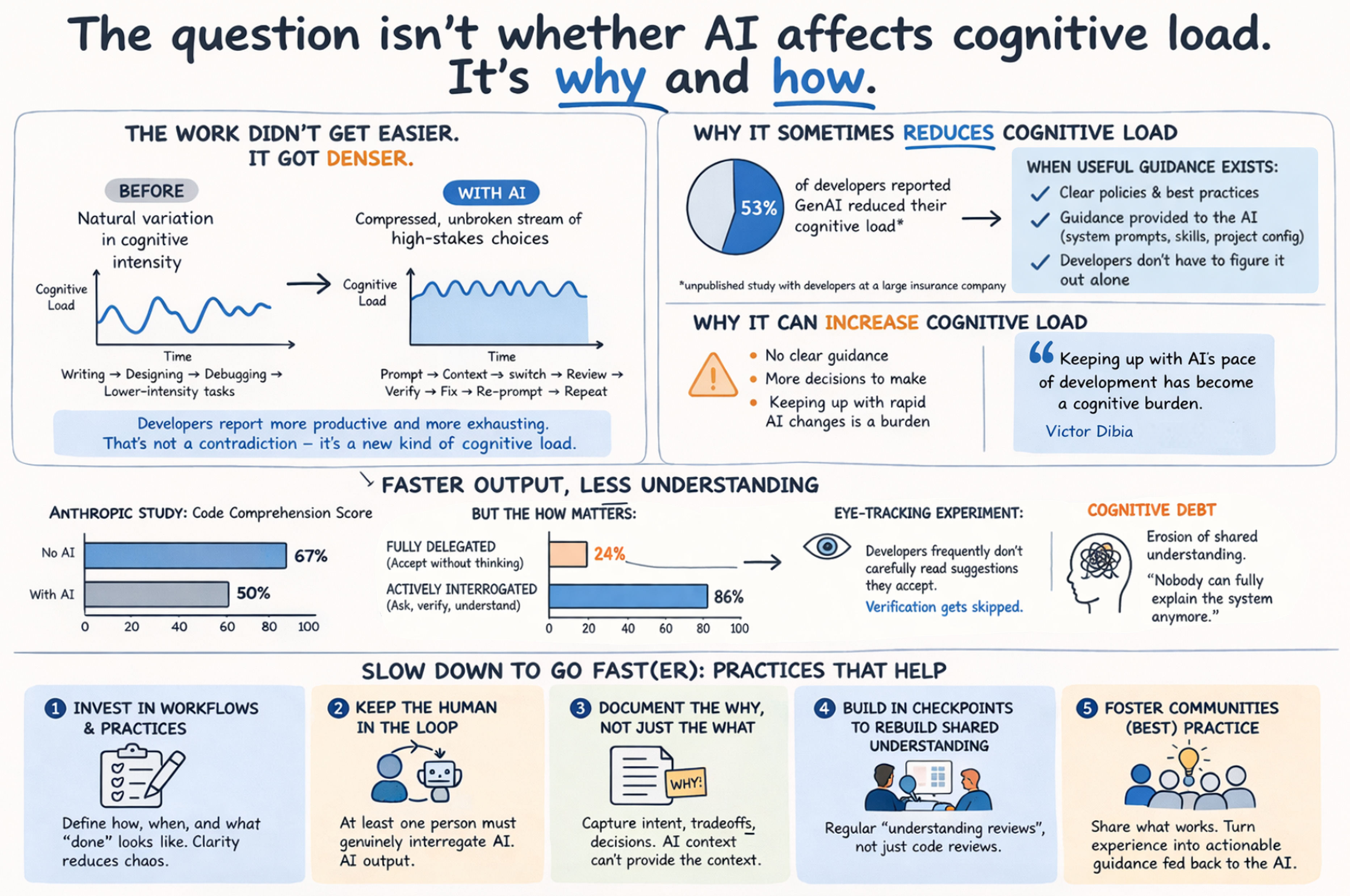
GenAI coding tools were supposed to free up mental capacity. Offload the boilerplate, the syntax, the repetitive work, and let developers focus on what matters. This goal was only achieved partially.

The question isn’t whether AI affects cognitive load. It’s why and how.

Read more →

#5: Trust is a Bottleneck for GenAI Adoption in Software Development

Why nearly half of developers *actively* distrust AI tools — and what the research says actually changes that.

According to the Stack 2025 Overflow Developer Survey with over 33,000 respondents, only 3% highly trust the accuracy of AI tools, while 46% actively distrust them. This isn’t a niche concern, it’s a large part of the developer population, and it not only impacts adoption of AI tools, but how they impact productivity.

Read more →

Forbes: 3 Ways Managers Can Make Teams More Productive

This post first appeared in Forbes on June 25, 2025 and was written by Prof. Dr. Lauren Howe, one of our research collaborators.

Work today is full of interruptions. The constant influx of emails, notifications, and questions from co-workers can slow individual progress and create a sense of frustration. After all, most people want to feel productive and work toward crossing off important goals from their to-do list.

But productivity is more than a one-person show: it’s a team effort. Recognizing this can help managers to make their teams more productive.

1. Signal Team Member Availability

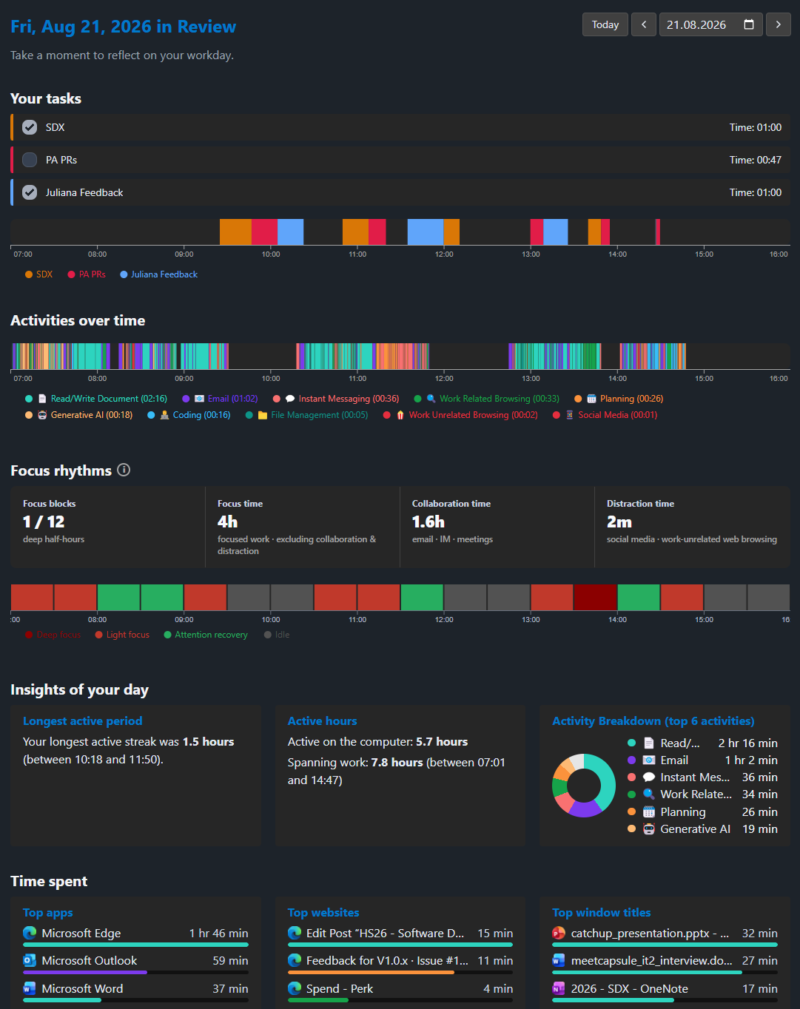
One solution is to let team members know when they should avoid interrupting people, so that focus time is protected. To accomplish this, a team of researchers at the University of Zurich developed the “FlowLight,” a tool that detects when a worker is focused and signals availability for interactions to others. First, the tool measures whether workers are in a state of “flow,” detecting this through computer activity like keyboard and mouse usage. Then, the tool signals via a lightbulb mounted nearby whether now is a good time for interruptions. Like a traffic light, red signals that a person should not be interrupted as they’re in the midst of deep work, while green means go ahead.

Read more →

Podcast folge zu Modern Work: Wie können wir unsere Produktivität durch Selbstreflektion steigern?

In der dritten Folge des DSI Podcasts «Genial digital?» spreche ich mit Podcast-Host Milena Ragaz über den täglichen Gebrauch von Handys und Computern. Wie nutzen wir diese digitalen Geräte im Alltag und bei der Arbeit? Und vor allem: wie können wir sie nachhaltig nutzen, um künftig neben unserer Produktivität auch unser Wohlbefinden zu steigern?

Milena Ragaz besuchte mich in meiner Funktion als DSI Forscher in meinem Büro am Institut für Informatik der Uni Zürich. Dabei sprachen wir unter Anderem über PersonalAnalytics, RescueTime und Apple Screen Time. Das sind alles Ansätze, um unsere eigene Gerätenutzung besser zu verstehen.

Wir diskutieren Erkenntnisse diverser Studien, welche wir mit PersonalAnalytics durchgeführt haben, und ich teile konkrete Tipps, wie die digitale Selbstbeobachtung und -Reflektion nachhaltig wirken kann.

Read more →

Podcast Folge zu “Flow statt Frust”: Wie wir Unterbrechungen minimieren und den Fokus bei der Arbeit verbessern

Ein kurzer Teams-Chat hier, ein Zoom-Meeting dort – und zwischendurch noch die “ganz kurze” Frage von der Chef:in. Kein Wunder, dass Fokus oft auf der Strecke bleibt.

In der aktuellen Folge des Podcast Schampar Digital habe ich mit Frank Richter über genau dieses Thema gesprochen:

Wie wirken sich ständige Unterbrechungen auf unsere Arbeit aus – und welche Strategien helfen, um Flow statt Frust zu erleben?

🎧 Jetzt (auf Schweizerdeutsch) anhören auf Spotify, YouTube oder Apple Podcasts:

Read more →

Better Balancing Focused Work and Collaboration in Hybrid Teams by Cultivating the Sharing of Work Schedules

I am thrilled to announce the acceptance of our newest FlowTeams-paper that marks a continuation of our seminal FlowLight-paper. This blogpost first appeared in the FlowLabs blog.

Multi-tasking Craziness in Hybrid Teams

A key challenge that knowledge workers in hybrid teams face nowadays revolves around finding a balance between focused work and collaborating with their team to support them. When an individual spends too much time with teamwork, individual productivity might suffer. Conversely, when focusing only on progressing one’s own work, teamwork suffers and co-workers might remain blocked with unanswered questions.

Read more →

Hybrides Arbeiten oder weshalb wir Mitarbeitende nicht zurück ins Büro zwingen sollten [German article]

I was recently invited to contribute an article to the alumni magazine of the Department of informatics (of the university of Zurich). In that article, I talk about challenges of hybrid work and give a few concrete pointers towards tackling them, by involving the team.

In einer Arbeitswelt die sich durch die Covid-Pandemie rasant verändert hat, stehen Unternehmen vor der Herausforderung ihre Arbeitsmodelle neu zu definieren. Immer öfters möchten sich Arbeitnehmende nicht mehr nach traditionellen Arbeitsformen richten, wie beispielsweise täglich von 9-5 im Büro zu arbeiten und immer öfters fordern sie flexiblere, hybride Arbeitsprozesse. Um diese effizient umzusetzen und schlussendlich sogar als Wettbewerbsvorteil für die Gewinnung und langfristige Bindung von Talenten zu nutzen, beschreibt dieser Artikel einige Gedankenanstösse basierend auf Forschung mit und Beratung von Schweizer Unternehmen.


Grosse Technologieunternehmen wie Apple und Microsoft haben in den letzten Jahren Milliarden in den Ausbau ihrer Hauptsitze investiert, nur um sie nun grösstenteils leer vorzufinden. Auch in der Schweiz lesen wir ähnliche Schlagzeilen, wie jene von Roche, die den Bau des geplanten höchsten Büroturms der Schweiz, dem Bau 3, verschoben hat um das Bürokonzept zu überdenken. Dies beruht meist nicht auf massiven Fehlkalkulationen jener Unternehmen. Da sich solche Projekte von der Planung bis zur Umsetzung oft über mehrere Jahre erstrecken, konnte die Covid-19-Pandemie innerhalb weniger Monate die Art und Weise wie Unternehmen ihre Büroräumlichkeiten nutzen, grundlegend umkrempeln. Viele Wissensarbeitende möchten nicht mehr täglich den Weg ins Büro auf sich nehmen. Trotzdem sollen diese Investitionen sinnvoll genutzt werden.

Read more →

Hybride Arbeit oder alle zurück ins Büro? [German article]

Abraxas, a leader in innovative and secure ICT solutions for Swiss government agencies, recently invited me to write an article on how organizations can leverage hybrid work as a market advantage and to better balance focus and teamwork, while at the same time ensuring data privacy and security, especially nowadays with the omnipresent AI tools, such as ChatGPT. The article appeared online and in-print in the Abraxas Magazine.

Read more →

DSI Insights: New Work oder die Balance zwischen Fokusarbeit und Teamwork [German article]

This German article was written as a collaboration with the Digital Society Initiative of the University of Zurich and first published on Inside IT, later on UZH News.

New Work erlaubt mehr Flexibilität beim Organisieren und Strukturieren der eigenen Arbeit. Dies kann zwar zu erhöhter Produktivität führen, aber die Teamarbeit leidet öfters darunter. Wie geht das unter einen Hut?

Read more →

How to Organize your Workday for increased Focus at Work

As knowledge workers, we rely on our ability to concentrate and complete our tasks efficiently and effectively. However, with the constant influx of new information, interruptions from co-workers asking for help and distractions, it can be a major challenge to stay in focus for more than a few minutes at a time. Balancing all the different activities and duties and constantly recovering from interruptions throughout the day can be taxing on workers, resulting in higher stress, reduced motivation and more errors. In addition, finding such a balance can be challenging due to intricacies of everyday work, such as unplanned tasks or problems coming up, the natural need to collaborate frequently within and across teams, personal preferences on when and how to communicate and work, as well as trends towards remote/hybrid work.

Read more →

Experimenting with Walk Meetings and Creativity-boosting Walks

A couple of years ago, I’ve started experimenting with walk meetings for the first time, and briefly wrote about them in my blog. Little did I know back then that I would suddenly have way more time to walk, and that being outside was the only relatively safe way to talk to people face-to-face, and to limit risking an infection with COVID-19.

At work, spending an entire day in meeting rooms at the office or in a Teams or Zoom-meeting at the home office is certainly not very appealing, and spending that time sitting is actually quite unhealthy. After all, our bodies are not made for sitting, but we’re nonetheless sitting on average 9.3 hours a day, and this was before the pandemic!

Read more →

Podcast Episode on Developers’ Diverging Perceptions of Productivity

Recently, Abi Noda and I talked about our Book chapter in the ‘Rethinking Productivity in Software Engineering‘ book on our research to better understand software developers’ perceptions of productivity, and how these insights might be applied by managers and team leads in software teams.

Read more →

Remotely collaborating on knowledge exchange & learning during a Pandemic

Staying motivated and continuing information flow and knowledge exchange is very challenging during a pandemic, especially for teams which are not used to the remote-only setting.

In this blogpost that we published in the Balzano Informatik AG Blog, I write about the four new tracks we’ve introduced at Balzano Informatik AG to foster continuous learning and knowledge exchange for our work on ScanDiags.

Read more →

Enabling Good Work Habits in Software Developers through Reflective Goal-Setting

I am thrilled to announce our most recent paper on how we are helping developers become more productive and enable better work habits through reflective goal-setting. IT was recently accepted to the IEEE Transactions on Software Engineering Journal.

Co-Authors: André N. Meyer (University of Zurich), Gail C. Murphy (University of British Columbia), Thomas Zimmermann (Microsoft Research), Thomas Fritz (University of Zurich).

You may download the pre-print here.

Read more →